My work in the European WHY project
This post is an article (originally in Spanish) I co-wrote for the Journal of the Faculty of Engineering of the University of Deusto.
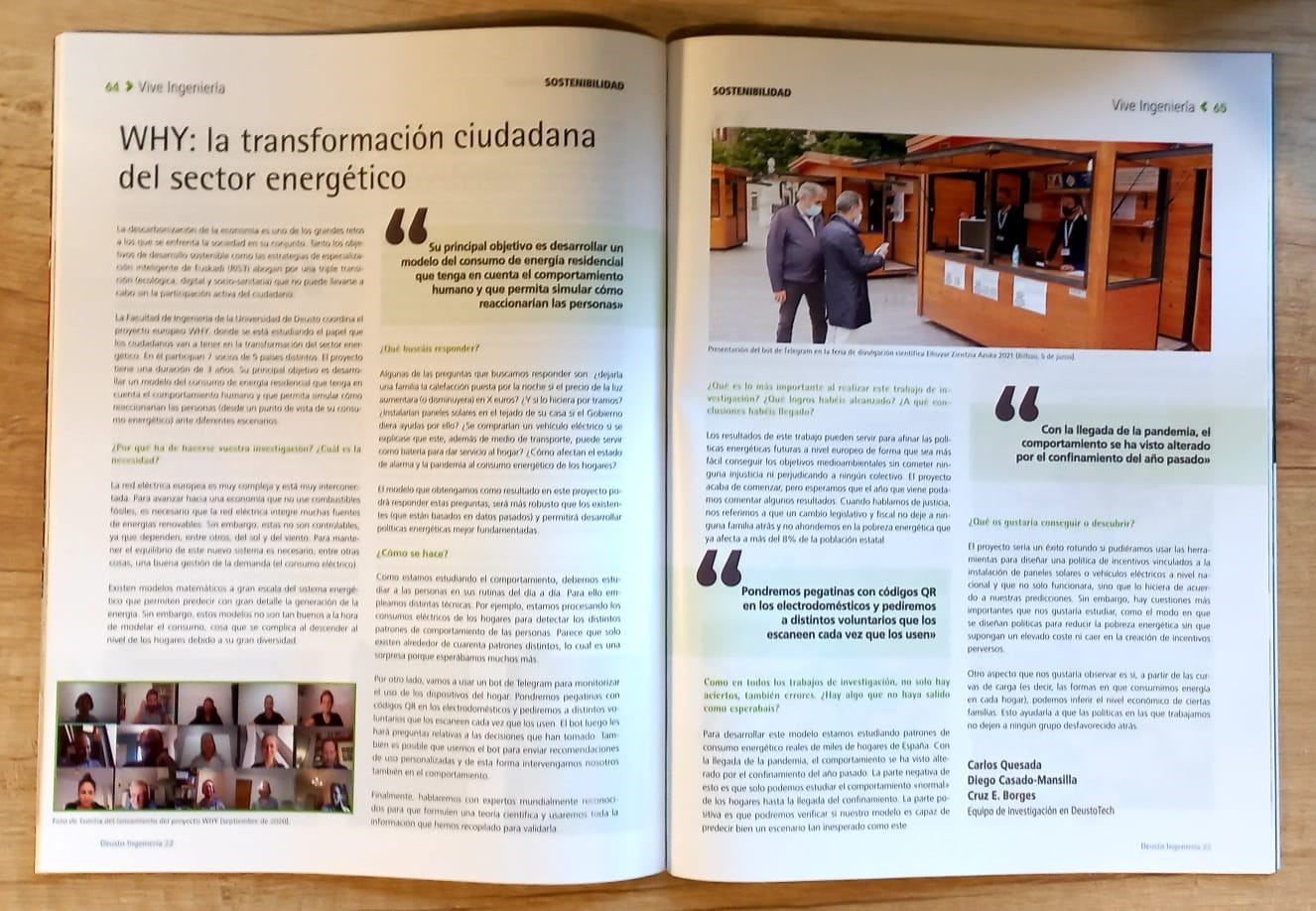
One of the major challenges facing society as a whole is the decarbonisation of the economy. Both the sustainable development objectives and the intelligent specialisation strategies of the Basque Country (RIS3) support a triple transition (environmental, digital and social), which cannot be achieved without the active participation of citizens.
The Faculty of Engineering of the University of Deusto is coordinating the European WHY project, which examines the role that citizens will play in the transformation of the energy sector. It involves seven partners from five different countries. The project will last three years. Its main objective is to develop a model of residential energy consumption that takes into account human behaviour and makes it possible to simulate how people would react to different scenarios in terms of their energy consumption.
Why does your research need to be done? What is the need?
The European electricity grid is very complex and highly interconnected. In order to move towards a non-fossil fuel economy, the electricity grid needs to integrate many renewable energy sources. However, these are not controllable as they depend on the sun and wind, among other things. In order to maintain the balance of this new system, it is necessary, among other things, to manage demand (i.e. electricity consumption).
There are large-scale mathematical models of the energy system that can predict energy production in great detail. However, these models are not as good at modelling consumption, which becomes more difficult when you get down to the household level because of the great diversity of households.
What do you aim to answer?
Some of the questions we want to answer are: Would a family leave the heating on at night if the price of electricity rose (or fell) by X euros? Would they install solar panels on the roof of their house if the government offered subsidies? Would they buy an electric car if it was explained that it could be used not only as a means of transport but also as a battery to power the home? How will the state of alert and the pandemic affect household energy consumption?
The model that will emerge from this project will be able to answer these questions, will be more robust than existing models (which are based on historical data) and will allow better informed energy policies to be developed.
How is this done?
Because we study behaviour, we need to study people in their daily routines. We use different techniques to do this. For example, we process household electricity consumption to identify the different patterns of people’s behaviour. It seems that there are only about forty different patterns, which is surprising because we expected many more.
On the other hand, we will use a Telegram bot to monitor the use of household appliances. We will put stickers with QR codes on household appliances and ask volunteers to scan them every time they use them. The bot will then ask them questions about the choices they have made. It is also possible that we will use the bot to send personalised usage recommendations, so that we can also intervene in behaviour.
Finally, we will talk to world-renowned experts to formulate a scientific theory and use all the information we have gathered to validate it.
What is the most important aspect of this research work? What have you achieved? What conclusions have you reached?
The results of this work can be used to fine-tune future energy policies at the European level in a way that makes it easier to achieve environmental goals without doing injustice or disadvantaging any groups. The project has only just begun, but we hope to be able to comment on some of the results next year. When we talk about justice, we mean that a legislative and fiscal change will not leave any family behind and will not deepen the energy poverty that already affects more than 8% of the country’s population.
As in all research work, there are not only successes, but also mistakes. Is there anything that has not turned out as you expected?
To develop this model, we are studying the real energy consumption patterns of thousands of households in Spain. With the arrival of the pandemic, behaviour has been changed by last year’s lockdown. The disadvantage of this is that we can only study the ‘normal’ behaviour of households until the arrival of the containment. On the positive side, we will be able to test whether our model is good at predicting such an unexpected scenario.
What would you like to achieve or discover?
The project would be a huge success if we could use the tools to design an incentive policy linked to the installation of solar panels or electric vehicles at a national level that not only works, but works according to our predictions. But there are more important issues that we would like to look at, such as how to design policies that reduce fuel poverty without being costly and without creating perverse incentives.
Another aspect we would like to look at is whether we can infer the economic status of particular households from load curves (i.e. the way we use energy in each household). This would help to ensure that the policies we are working on do not leave vulnerable groups behind.